
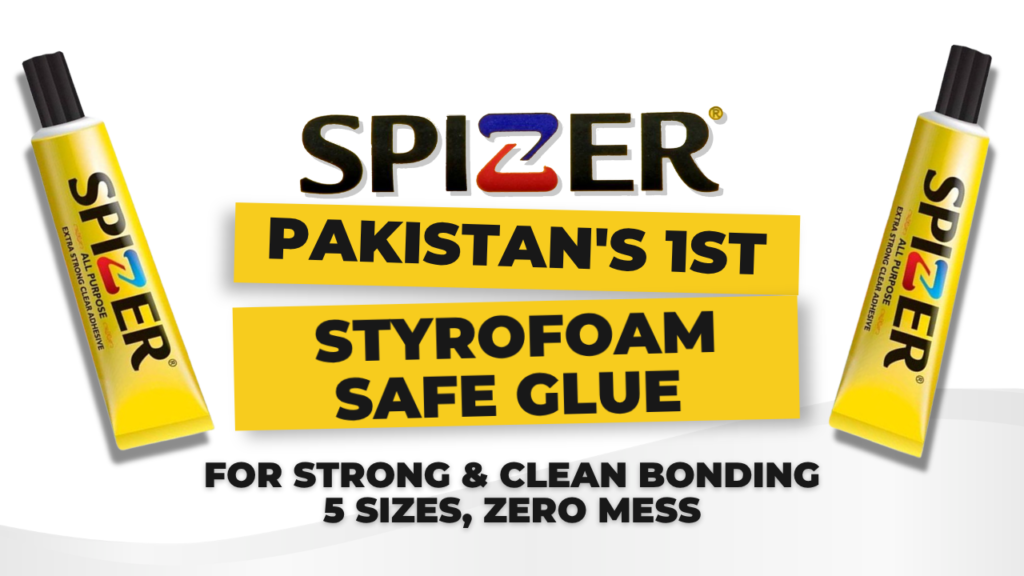
If you’ve ever watched a carefully built school project crumble apart because the glue ate straight through the thermopore, you already know the frustration. Regular glues and Styrofoam simply don’t get along — and for years, people across Pakistan had no real solution. They made do with weak alternatives, patchy fixes, or accepted the mess. That changes now.
Spizer Glue is Pakistan’s first Styrofoam-safe glue , purpose-built for clean, strong, and reliable bonding on foam, wood, leather, plastic, textile, and paper. Whether you’re a student building a model, a craftsperson working on a commission, or a homeowner fixing something around the house, Spizer is engineered to get the job done — without damaging the material underneath.
This article covers everything you need to know: what makes Spizer different, where you can use it, how to apply it correctly, and why it’s genuinely the smartest glue choice available in Pakistan today.
The Common Problem with Regular Glues
Walk into any stationery or hardware shop in Pakistan and you’ll find a row of glues — UHU, Super Glue, Fevicol, and dozens of local alternatives. They work fine on paper, wood, or hard plastic. But the moment Styrofoam (locally called thermopore) enters the picture, things go wrong fast.
Most standard glues are solvent-based. That means they contain chemical compounds — typically acetone, MEK, or other organic solvents — that dissolve polystyrene foam on contact. You don’t even need to wait for it to dry. The damage happens the second the glue touches the surface. The foam melts, warps, or develops pits. The bond, if it forms at all, is weak and uneven. The finish looks terrible.
This isn’t a minor inconvenience. It’s a real, recurring problem for students, crafters, packaging professionals, and small business owners who work with thermopore regularly.
Why Styrofoam Gets Damaged Easily
Styrofoam, or expanded polystyrene (EPS), has a unique structure. It’s made up of approximately 98% air trapped inside a network of very thin polystyrene walls. This is what makes it so lightweight and useful for insulation, packaging, and creative projects. But it also makes it incredibly sensitive to chemical exposure.
When a solvent-based glue contacts the foam’s surface, the solvent breaks down the polystyrene chains almost instantly. The material literally dissolves — and since the walls are so thin, there’s very little resistance. The result is an irreversible mess: a dented, bubbled, or completely eaten-through surface that can’t be repaired.
Even some “all-purpose” glues marketed as multipurpose glues cause this reaction. The labelling doesn’t always make it clear, which means consumers discover the problem only after the damage is done.
Everyday Situations Where This Becomes a Problem
The frequency with which thermopore damage occurs in everyday life is genuinely surprising once you start paying attention. Here are the most common scenarios:
- School projects: Students in Pakistan frequently build model buildings, solar system displays, and science fair structures using thermopore sheets. One wrong glue choice, and hours of work collapse into a warped, melted mess the night before submission.
- Craft and hobby work: Artists and craftspeople who use thermopore as a base or sculpting material — for floral arrangements, miniatures, or decorative pieces — regularly deal with glue damage that ruins the finished product.
- Foam packaging repairs: Retailers and e-commerce sellers who reuse thermopore packaging to protect fragile goods often find that standard glues won’t hold the pieces together properly, or they damage the foam in the process.
- Interior decoration: Foam-based ceiling tiles, lightweight wall panels, and decorative mouldings installed using the wrong glue can bubble, crack, or fall off entirely.
None of these situations need to happen. They’re all caused by the same root problem: using an glue that wasn’t designed for thermopore. Spizer was built specifically to close this gap.
Introducing Spizer – A Smarter Glue Solution
Spizer is a next-generation glue brand developed with the Pakistani market in mind. It’s not a generic import — it’s a product designed around the actual bonding challenges that people in this country face on a daily basis. And its flagship feature is the one that sets it apart from everything else on the shelf: it’s completely safe to use on Styrofoam.
Pakistan’s construction, education, and DIY sectors rely heavily on thermopore. It’s affordable, widely available, and incredibly versatile. Yet until Spizer, there was no glue specifically formulated to bond with it safely. That’s a gap that should’ve been filled a long time ago, and Spizer fills it — with a product that also works on wood, leather, textile, paper, and plastic.
What Makes Spizer Different
Spizer isn’t just a “foam-friendly” label slapped onto an existing formula. The glue is genuinely formulated to avoid the solvents that damage polystyrene while still delivering strong, lasting bonds across multiple surface types. Here’s how it stands out:
- Styrofoam-safe formulation: No solvents that dissolve or melt polystyrene. The foam stays intact, holds its shape, and bonds cleanly.
- Multi-material compatibility: Works effectively on wood, leather, textile, paper, and plastic — making it a single solution for multiple bonding needs.
- Everyday usability: Available in five sizes, easy to apply, and designed for both household and professional use without requiring special training or equipment.
- Locally positioned: Priced and packaged to suit the Pakistani market, where affordability and accessibility matter as much as performance.
This combination of safety, versatility, and accessibility is what positions Spizer as a genuinely smarter glue choice — not just a novelty product for a niche use case.
Key Features That Make Spizer Stand Out
Let’s get specific. Here’s a breakdown of Spizer’s core features and why each one matters in practical, everyday use.
Styrofoam Safe Formula
This is the headline feature, and it earns its place at the top. Spizer’s formula does not contain the reactive solvents found in standard glues . When applied to Styrofoam or thermopore, the glue bonds with the surface rather than dissolving it. The foam retains its shape, texture, and structural integrity throughout.
For anyone who has ever seen a thermopore model eaten through by regular glue, this is a genuine game-changer. The bonding surface stays clean, the material holds its form, and the final result looks exactly as intended.
Strong & Reliable Bond
Being foam-safe doesn’t mean being weak. Spizer creates a strong, durable bond that holds materials firmly in place once the glue has set. The bond resists moderate stress, making it suitable for structural joins in craft projects, small repairs, and light-duty applications across all compatible materials.
The strength of the bond comes from the glue’s ability to make proper contact with the surface rather than dissolving or sitting on top. When applied correctly — thin, even layer, proper pressure — Spizer holds.
Crystal Clear Finish
Visible glue marks are one of the most common complaints about glues used in craft and project work. Spizer dries to a crystal-clear finish, which means there are no white residue marks, no yellow staining, and no unsightly bead lines around the join. For school projects, display pieces, and decorative applications, this matters enormously.
A clean, invisible bond looks professional. It shows the material, not the join.
Fast Drying Performance
Time is often a constraint — whether you’re finishing a project the night before submission, completing a repair before a client visits, or working through a busy day at a craft business. Spizer’s fast-drying formula helps you move through work efficiently without long waiting periods between steps.
Fast drying also reduces the risk of accidental displacement while the bond is setting, especially on vertical surfaces or pieces that can’t be clamped.
Temporarily Adjustable
Before the bond sets completely, Spizer gives you a brief window to reposition joined pieces. This is a particularly useful feature for work where alignment matters — like mounting decorative elements, building symmetrical models, or fitting irregular shapes together.
This adjustability separates Spizer from instant-bond glues like super glue, which lock in position the moment contact is made. Spizer lets you get it right before it holds.
Materials Spizer Can Bond
One of Spizer’s biggest practical advantages is its multi-surface compatibility. It’s not a specialist product for one material — it works reliably across a wide range of surfaces that come up regularly in everyday Pakistani households, classrooms, craft spaces, and workshops.
| Material | Bonding Quality |
| Styrofoam / Thermopore | Excellent — foam-safe, no melting |
| Wood | Strong, clean bond |
| Leather | Flexible, holds under light stress |
| Textile / Fabric | Bonds without soaking through |
| Paper / Cardboard | Clean, clear join |
| Plastic (rigid) | Solid bond on compatible plastics |
Why Multi-Surface Bonding Matters
The economics of maintaining multiple glues at home or in a workspace adds up fast. Most households end up with a drawer full of half-used glue tubes: one for paper, one for wood, one for fabric, and still nothing that works safely on thermopore.
Spizer replaces that scattered collection with a single, versatile glue. That means fewer products to buy, fewer to store, and no more rummaging through a drawer trying to remember which tube is safe for which surface. One bottle handles it all — and it handles thermopore better than anything else on the Pakistani market.
Where You Can Use Spizer Glue
Spizer’s versatility extends across a wide range of real-world applications. Here are the environments where it performs best.
School Projects & Student Work
Students at every level — primary, secondary, and beyond — regularly work with thermopore for science models, geography displays, architecture projects, and creative assignments. Spizer is the glue that makes these projects work the way they’re supposed to, without the risk of the foam dissolving overnight.
Parents buying glue for their children’s projects can use Spizer with confidence. It’s effective, easy to apply, and doesn’t require adult supervision for the bonding itself (though general craft supervision for younger children is always recommended).
DIY Crafts & Creative Projects
Pakistan has a growing community of home crafters, small-scale decorators, and hobbyists who work with mixed materials regularly. Spizer handles the full range of craft bonding needs — floral foam bases, foam-backed fabric panels, handmade gift boxes, paper mâché builds on foam cores, and much more.
For anyone running a small home-based craft business, Spizer’s consistent, clean-finish bonding raises the professional quality of the final product.
Household Repairs
Everyday home repairs often involve bonding two different materials together quickly and reliably. A loose leather patch on a chair, a broken plastic cabinet hinge, a detached edge strip on furniture, a cracked thermopore ceiling tile — Spizer handles all of these cleanly and effectively without the need for specialised repair products.
Professional & Workshop Use
For craft businesses, prop makers, small-scale manufacturers, and workshop operators, consistent glue performance is a production requirement, not just a preference. Spizer’s reliable formula, multi-surface bonding, and clean finish make it a practical choice for small-to-medium professional applications.
Automotive Aftermarket
Light fixing and interior detailing work in the automotive aftermarket sector occasionally involves bonding foam insulation, lightweight trim pieces, fabric, and plastics. Spizer’s multi-surface capability and clean finish make it suitable for these light-duty automotive applications.
How to Use Spizer for Best Results
Getting the best performance out of Spizer comes down to correct application technique. It’s straightforward — but a few simple steps make a meaningful difference in the quality and strength of the bond.
Step 1 – Clean the Surface
Before applying any glue, make sure both surfaces are clean and dry. Remove dust, grease, loose particles, and any previous glue residue. Even a light layer of dust can prevent the glue from making proper contact with the material.
On thermopore, a dry cloth is usually sufficient. On wood or plastic, a slightly damp cloth followed by drying works well.
Step 2 – Apply a Thin Layer
Apply Spizer in a thin, even layer on one or both surfaces depending on the material and the size of the join. More glue doesn’t mean a stronger bond — excess glue can actually weaken the join, create visible marks, and extend drying time unnecessarily.
For small joins, the nozzle allows precise application. For larger surface areas, a spatula or applicator can help spread the glue evenly.
Step 3 – Join and Adjust
Bring the surfaces together carefully. During the initial open time before the bond sets, you can reposition the pieces to ensure correct alignment. Press firmly along the length of the join to ensure full contact between the surfaces.
Take your time here — the temporary adjustability window is one of Spizer’s most useful features, and using it well ensures a better final result.
Step 4 – Let It Dry
Allow the bonded pieces to sit undisturbed until fully set. Drying time varies depending on the materials, the thickness of the glue layer, and environmental conditions (temperature and humidity). In most standard conditions, the bond reaches working strength within a short period.
For load-bearing joins or applications where the bond will be under stress, allow the maximum recommended drying time before putting the piece into use.
Why Spizer is Ideal for Pakistan Market
Pakistan’s glue market has historically been dominated by international brands or cheap local alternatives with inconsistent quality. Spizer is different — it’s a product designed with Pakistani use cases, price sensitivity, and distribution realities in mind.
The prevalence of thermopore across Pakistani packaging, construction, education, and craft sectors creates genuine demand for a Styrofoam-safe glue. No international brand has specifically targeted this gap in the local market. Spizer fills it with a locally positioned product that’s affordable, widely available, and purpose-built for the materials Pakistanis actually work with.
Available Sizes
Spizer is available in five sizes to suit different users and usage volumes:
| Size | Best For |
| 7ml | On-the-go repairs, school use |
| 21ml | Light craft and home repair |
| 42ml | Regular craft projects |
| 63ml | Workshop and frequent use |
| 125ml | Professional and bulk use |
This range ensures that both occasional users and regular professionals can buy exactly the volume they need — no waste, no unnecessary expense.
Comparing Spizer with Regular Glues
| Feature | Spizer | Regular Glues |
| Styrofoam Safe | ✅ Yes | ❌ No — melts foam |
| Crystal Clear Finish | ✅ Yes | ⚠️ Often leaves residue |
| Multi-Surface Bonding | ✅ Yes | ⚠️ Usually limited |
| Temporary Adjustability | ✅ Yes | ❌ Usually instant-lock |
| Available in Multiple Sizes | ✅ Yes (5 sizes) | ⚠️ Limited options |
| Designed for Pakistan Market | ✅ Yes | ❌ Mostly imported |
The comparison is straightforward. For anyone who works with thermopore, or wants a single glue that handles multiple materials cleanly, Spizer is simply the better option.
Safety & Usage Tips
Spizer is designed for safe everyday use, but a few basic precautions ensure the best experience:
- Use in a ventilated area: Although Spizer is formulated to minimise harsh fumes, good airflow during application is always advisable.
- Keep away from children: Store Spizer out of reach of young children. Supervised use for school projects is fine, but unsupervised access should be avoided.
- Store properly: Keep the cap tightly sealed when not in use. Store in a cool, dry place away from direct sunlight and heat sources to preserve the formula and extend shelf life.
- Avoid contact with eyes and skin: In case of contact, rinse thoroughly with water. If irritation persists, seek medical advice.
- Dispose responsibly: Do not pour unused glue down drains. Follow local disposal guidelines for chemical products.
Frequently Asked Questions (FAQs)
Q1: What makes Spizer safe for Styrofoam when other glues aren’t? Spizer is formulated without the reactive organic solvents found in standard glues. These solvents are what cause polystyrene foam to dissolve on contact. By removing them from the formula, Spizer bonds to thermopore without damaging its structure — something no other widely available glue in Pakistan does reliably.
Q2: Can Spizer be used for heavy-duty bonding or construction applications? Spizer is designed for everyday, light-to-medium duty bonding — school projects, crafts, household repairs, and small professional applications. It’s not intended for heavy structural construction bonding. For high-load applications, a construction-grade glue specific to that use case would be more appropriate.
Q3: How long does Spizer take to dry completely? Drying time varies based on the materials being bonded, the thickness of the glue layer applied, and environmental conditions like temperature and humidity. Under standard conditions, an initial bond forms quickly, but full cure strength is achieved after allowing additional drying time. Thicker applications and porous materials may take longer.
Q4: Is Spizer safe for children to use on school projects? Spizer can be used by children for school projects with adult supervision. It should be stored out of reach of young children when not in use, and application should be supervised to ensure correct use and avoid skin or eye contact.
Q5: Which size of Spizer is best for occasional home use? For occasional household repairs and light craft projects, the 21ml or 42ml sizes are the most practical choices. They provide enough glue for multiple small jobs without excess waste.
Q6: Where can I buy Spizer Glue in Pakistan? Spizer is available through selected retailers across Pakistan. For the latest stockist and availability information, visit spizer.co for current distribution details.
Q7: Can Spizer bond leather and fabric together? Yes. Spizer is compatible with both leather and textile surfaces, making it suitable for fabric-to-leather joins in craft applications, small repairs, and accessory-making.
Final Thoughts – A Reliable Glue for Everyday Use
Pakistan needed a Styrofoam-safe glue long before Spizer arrived — and the demand was clearly there, proven by the number of people who had simply given up trying to bond thermopore cleanly. Spizer doesn’t just solve one problem, though. It delivers a genuinely well-rounded glue: foam-safe, multi-surface, crystal clear, fast-drying, and available in five sizes that suit every type of user from students to professionals.
The “first Styrofoam-safe glue in Pakistan” positioning isn’t just a marketing claim — it’s a factual differentiator backed by the formula itself. And in a market where thermopore is everywhere, that differentiator carries real weight. If you work with thermopore in any capacity, Spizer is the glue you should be using.


